
AcroYoga may look like a playful movement practice, but beneath the shapes it is a profound training ground for communication. This article explores how working with a partner refines the way you listen, express yourself, and relate both during the practice and in everyday life.
AcroYoga is often seen as a physical practice, but at its core it is a communication practice. When you balance, lift, support, or fly with another person, you enter a form of dialogue that is physical, emotional, and relational all at once. You learn to speak with breath, timing, presence, words, body-weight shifting and even subtle intention. And over time, and if you let them, those communication skills begin to transform the way you relate far beyond the mat.
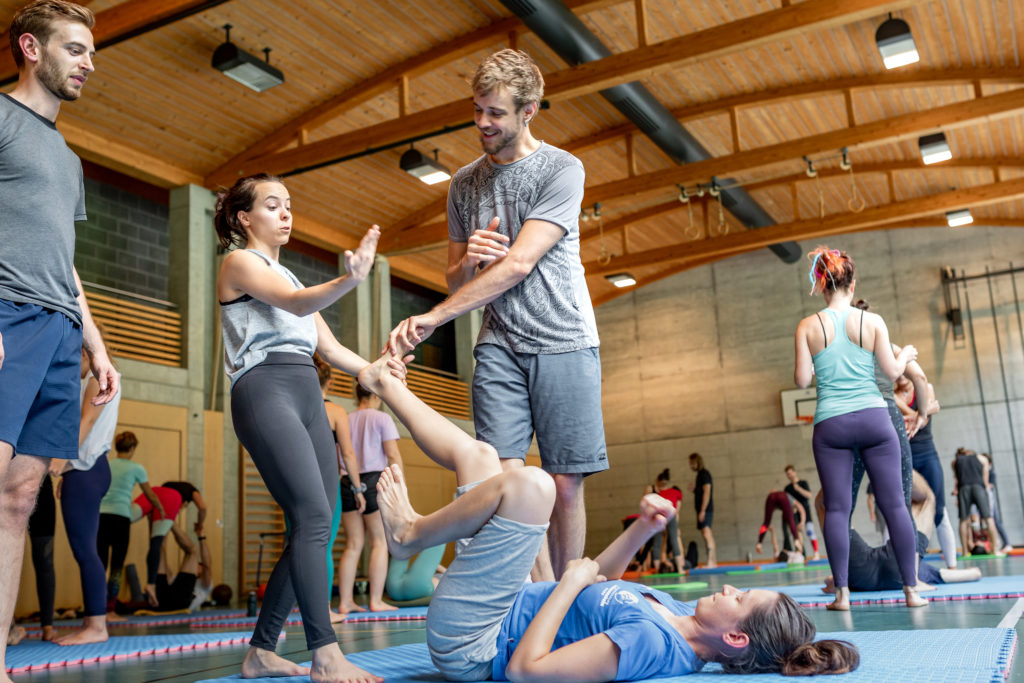
From the very first session, AcroYoga asks you to listen. Not only with your ears, but with your entire body. You start sensing how your partner breathes, where they hold tension, when they feel confident, and when they hesitate. Being a base or a flyer requires constant awareness of your own body as well as the other person’s. This is communication in its most fundamental form, a continuous exchange of feedback, support, and adjustment. You discover how to express your needs clearly and how to make space for another person to express theirs. You learn to pause, to reassess, and to choose safety over performance. These are the same relational skills that later show up in everyday conversations, conflicts, and collaborations.
AcroYoga (ideally) also cultivates a particular kind of honesty. Supporting or being supported requires vulnerability, and in a safe environment vulnerability becomes a source of clarity for everyone involved. When something doesn’t feel right or even hurts, you learn to voice it early and clearly. When you need more stability, more grounding, or more time, you learn to say so without apology. And when someone else shares a fear or hesitation, you learn to receive it without pushing, encouraging them to continue before they’re ready, or taking a hit to your ego. Instead of motivating your partner past their boundaries, you can practice offering presence, patience, and reassurance that they can slow down or stop at any time. These are profound communication skills, especially in a world where people often override their own signals to please others or avoid disappointing someone.
Something that is particularly interesting, is that AcroYoga is like a perfect a mirror for relational dynamics, and it teaches us not only through ease but especially through tension and challenging moments. One of the most common communication pitfalls arises when the base and flyer interpret the situation from fundamentally different vantage points. A base often sees what is happening; a flyer often feels a lot of what is happening. These are two entirely different data streams. When stress or insecurity creeps in, it is easy for bases to say things like “You’re all crooked up there, why aren’t you sitting straight?!” or for flyers to reply with “You’re not holding me properly, I can’t straighten my spine like this!” Both are perfectly understandable perspectives but that’s exactly what they are: two different perspective. If we are not conscious of this, we can create a pattern of blame rather than collaboration. So, acknowledging that firstly, there are two different people, aka two different perspectives with different lived experiences, now we also have physically different perspectives, i.e. angles from which we see, or like we already said, different data streams (visual vs. sensory).
This is where AcroYoga offers a beautiful metaphor for relationships in general. Two people almost never experience a shared moment in the same way. One person has more visual information, the other has more somatic information. One perceives angles and structure, the other perceives sensation and balance. Both perspectives are valid. Both are incomplete. Neither can be the whole truth without the other.
Learning to communicate well in AcroYoga means learning to bridge these perspectives. Instead of accusing, you learn to describe your internal experience. Instead of correcting your partner from a place of frustration, you learn to share what you are seeing or feeling with curiosity. “I feel a pull to the left. Can we check the alignment?” communicates far more skillfully than “You’re all crooked up there.” And “My right foot feels unstable in this position. Can we pause?” is far more helpful than “You’re holding me wrong.” This shift from blame to shared exploration is one of the most powerful relational skills AcroYoga teaches, and it carries far beyond the mat.
Practicing with different partners reinforces this adaptability. Some people are expressive, others quiet. Some move quickly, others slowly. Some are confident, others cautious. As you navigate these differences, you develop relational intelligence. You become better at reading subtle cues, adjusting your communication style, offering clarity without pressure, and inviting clarity from others without judgment. Over time, these skills begin to shape how you talk, listen, and relate in your everyday life. You interrupt less because you’ve learned to attune. You express boundaries more clearly because you’ve practiced it repeatedly in a context that requires it. You notice emotional shifts earlier because your nervous system has been trained to pay attention. You listen not just for words, but for breath, tension, rhythm, tone, and presence.
In essence, AcroYoga is a laboratory for communication. It teaches you to express yourself honestly, to receive others with openness, to co-regulate through challenge, to replace blame with curiosity, and to cultivate trust that is rooted in mutual respect and teamwork rather than force. The communication you build on the mat becomes a way of being. It follows you into your relationships, your work, your friendships, and the way you show up in the world.



About Mountain Moves
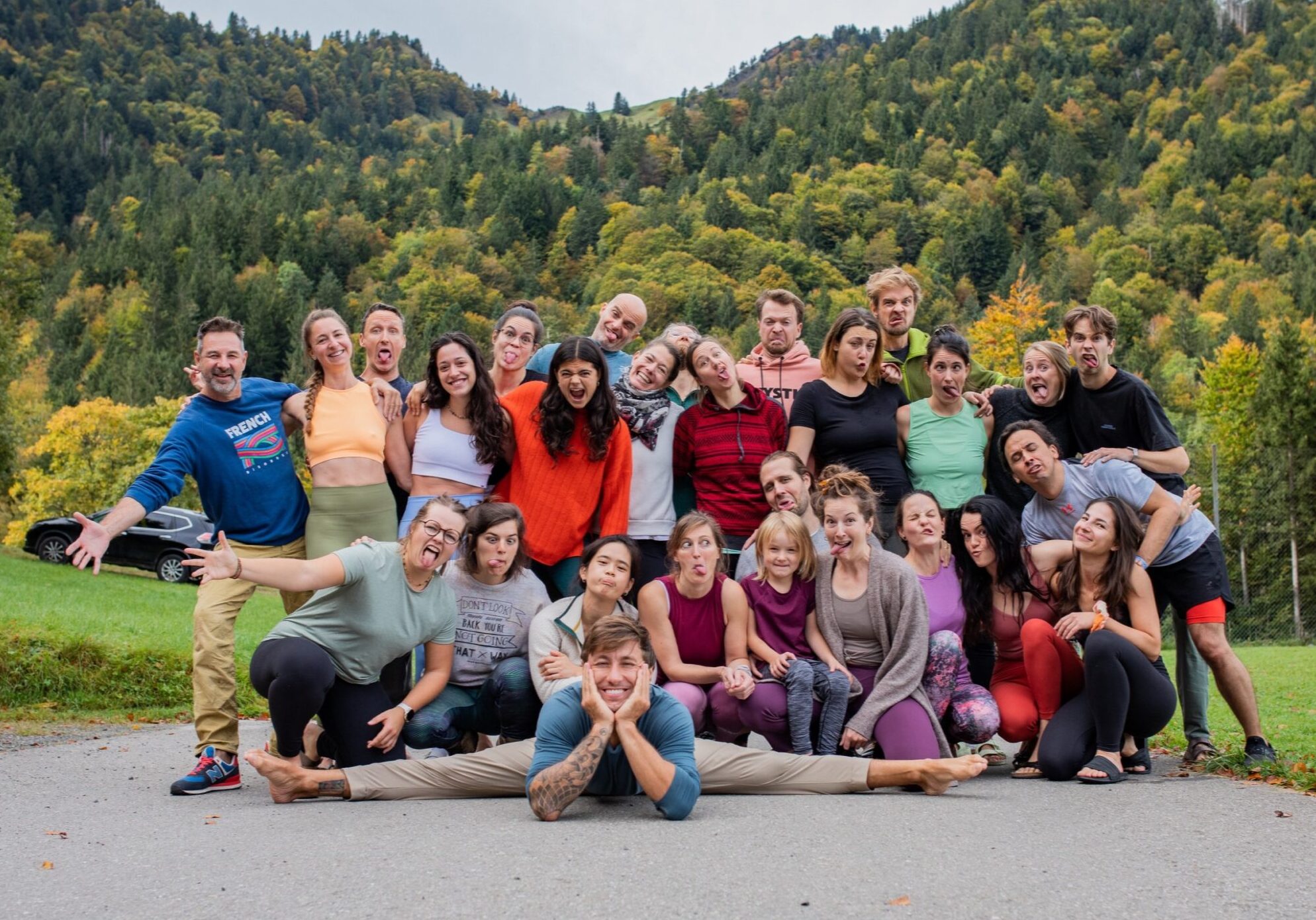
Mountain Moves offers residential AcroYoga retreats in Switzerland. The focus is on community, quality teaching, and providing an inclusive and nurturing environment for learning and growth. We welcome participants of all levels, from complete beginner to more seasoned AcroYoga practitioners.